

We know that spending too much time on our phone is bad for us.
Everyone is telling us.
And yet – the second a room goes quiet, a thought gets uncomfortable, or there is simply nothing happening for sixty seconds – we reach for our phones without even deciding to.
I struggle with that too.
The thing is, I don’t think this addiction-like behaviour is a social media problem.
I think it’s much deeper than that.
Part 1 - The way in
When we look at the “why” someone is reaching out for their phone, we can see 2 main reasons:
Comparison with others
The dopamine craving in a world with no dopamine
As social beings we developed a strong survival mechanism that needs a tribe.
In this tribe there were clear roles and hierarchies to ensure that the whole group can survive.
Based on that ancient way living we developed the skill of comparison.
An analytical skill newborns use to mimic their parents – to be liked and become part of their tribe.
As adults, we keep that same skill to stay in our social groups by adapting our behaviour.
Comparison is also for us the easiest way to decide where we stand in the tribe, how much influence we have in it and how likely it is to be kicked out.
So, comparing to others is actually very normal and biologically wanted.
However, in the last hundred to thousand years a lot has changed.
We started to build cities that became larger and larger.
And in the last 100 years the world wide web emerged and with it, social media in the last 30 years.
The pool of possible comparisons grew from the small family tribe in the cave during the day, to a small village, then to an ancient city to now the entire world 24/7.
But not everyone uses social media for comparison.
For many of us, and I belong to that group myself, is social media a quick and easy way to feel something positive after a workday.
We live in a world where humanity created meaningless “bullshit jobs”, a term popularized by David Graeber.
We live in grey cities with working hours high enough to deplete us but short enough to argue that we have free time.
In this world we lost something greater - meaning.
And this meaning was the main drive that gave our brains dopamine to feel satisfied after a long day of hunt.
We had the feeling that our doing is enough to survive and that we are the reason our families are happy.
But now we don’t.
So, we grab our phones and watch funny cat videos because they give us a sense of peace and happiness.
Some of us even tend to blow out their frustration by engaging with negative news.
What we do not realise or even ignore is that we are destroying what’s left - our ability to create.
Part 2 - The artificial infectious tick
It is easy to blame the digital age or specifically social media for this development.
However, I do believe that social media as a consumer good is just an artificially created symptom to satisfy a completely other dimension of human nature - greed.
But that is a bigger topic for another time.
Nonetheless, the picture I want to paint here is that our unhealthy scroll behaviour is like a disease spreading from an artificial tick called social media.
One that was looking for the perfect host.
It was, in my opinion, inevitable that social media would arise on the world wide web, as we crave novelty, connection and also comparison.
And as research went deeper into the field of psychology those tech-industries behind social media optimised their grip on us with addiction supporting features.
One of these features is called “Variable Reward Schedule”, where we get at a random schedule random quality of reward.
In a study with pigeons, researchers gave one group food after picking a fixed time on a button.
The second group also got food because they picked on a button, but the number of picks varied constantly.
The researchers observed that the second group started picking at the button way more often and intensely as if they got addicted to the progress.
The same principle is used in casinos with slot machines to bind the player to the game.
Social media companies use the exact same principle in the scroll feed.
You never know when the next for you engaging clip or information will show up.
The big difference is the currency we pay at this accessible slot machine.
We do not pay with money.
We pay with our attention and therefore our time.
There is no limit that could stop us from playing the game beside death.
And death feels far away for most of us.
When I want to look up something specific on YouTube, I have to be cautious after that one video not to binge-watch 3 more.
I always find something worth watching after scrolling through the recommendations just a little bit.
And that is the variable reward schedule on social media in action.
Just a little bit longer scrolling then I will get something worth the effort.
The moment we pause our online presence and return into our lives, notifications remind us to return to the endless stream of potential rewards.
Features designed to pull us back – likes, comments, notifications – increase our attachment to the platform.
They satisfy our need to compare and to connect with others.
We feel good receiving positive feedback and get sad or even anxious when we receive none or bad ones.
This is even supported through a culture of judgement and egoism as a form of bad individualism.
At the end of the day nobody will stop us from drowning deeper and deeper into the social media abyss as nobody really learned how to deal with it.
How could they?
Our brain developed over thousands of years, but social media has only existed for roughly 2 Generations.
Part 3 - The Price We Pay
So what happens to our minds that never learned to swim?
Social media gives us a nearly endless possibility to compare and escape.
There is never an ending and the process itself does not feel refreshing either.
And for both the result is the same:
We are not giving our brain a break.
And not having a mental break does have significant consequences:
decision making feels tougher and the decisions made have lower quality
our attention span decreases
our creativity tanks
our sleep gets more restless
we learn less and keep less of what we learned
Life starts to be tougher and more boring than before and we cannot grasp why.
But just to make it clear:
This felt boredom is not real boredom.
It is over stimulation of the brain which than craves even more stimulation to feel again.
The dopamine threshold to feel happy or interested gets shifted.
And all of this happens already after 30 independent information per hour.
30 tweets, 30 shorts or 30 things happening in a hijacked video - that’s it.
Most people do not even know, that our brain has a limited capacity build in to protect itself.
When was the last time you were able to sit with your own thoughts without the urge to distract yourself from them?
And we are not talking about a small problem here.
Next time you wait in a waiting line, instead of taking your phone out, look around.
Observe how the others around you behave.
I will guarantee you, that 90% of people will be on their phone.
We forget how to deal with quiet moments without input.
What many don’t know – and honestly, I didn’t either before researching this topic – is that we simultaneously forget how to self-reflect, plan for the future and build an individual identity.
What we know from muscles - use it or lose it - applies the same way for the brain and it’s active use of the so called default mode network.
The default mode network is basically a program that activates when we not consume.
This is the state where we learn, memorise and create new neurological connections.
In this state the brain seeks novelty and new connection from the known.
We enter the Flow state.
The state of the highest creativity and the highest quality of intellectual work.
So social media does not only cost us time.
It costs us the self.
Our Identity.
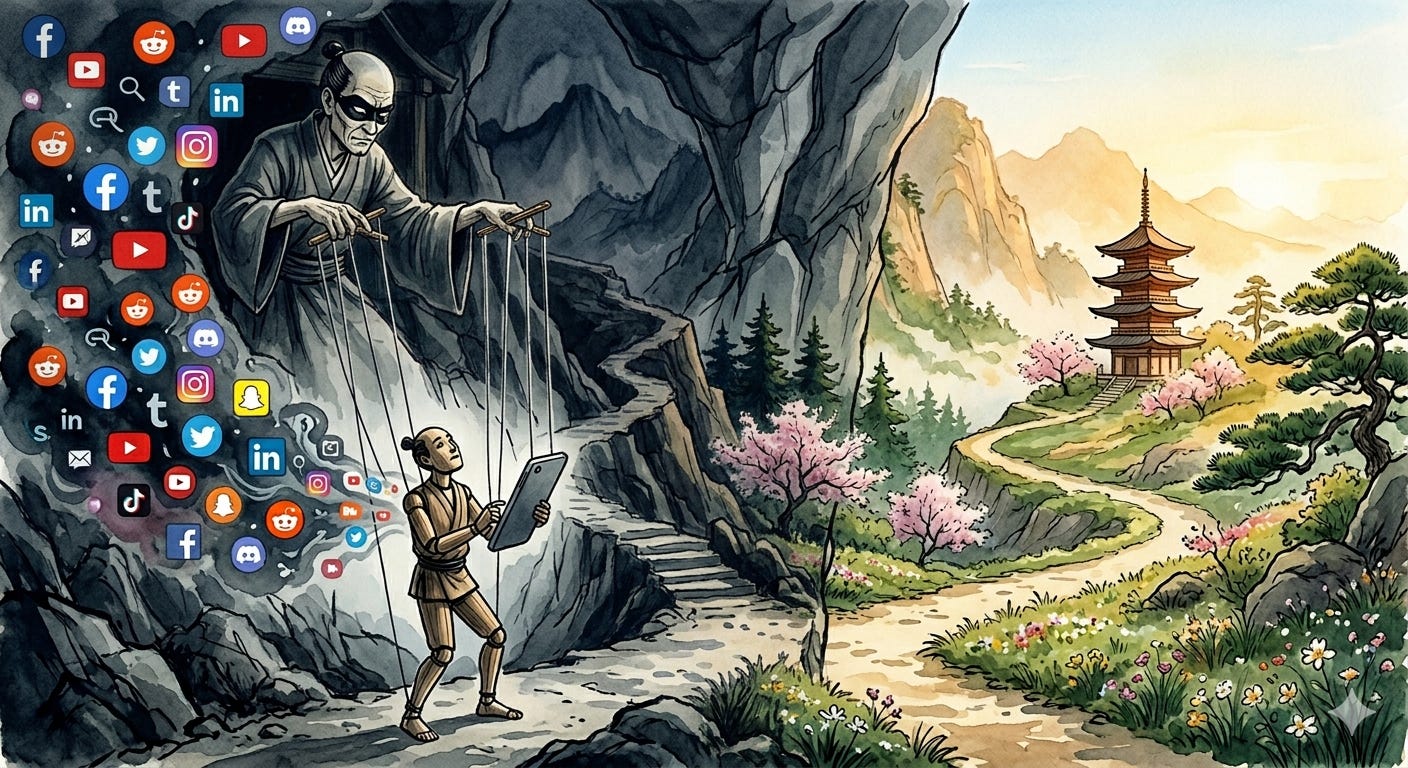
We become puppets, that see, judge and think like the feeds want us to be.
We stop using our own minds and give others the permission to dictate the trajectory of our lives.
Social media invites us to stay still but staying still does not mean to pause.
It means to decay.
Slowly and invisible until it’s either too late or a life-changing event opens our eyes.
But there are solutions to protect us.
Right now, while writing this essay, I am also doing a 30-day wall staring challenge.
But the long-term solution requires more than that.
Part 4- Solutions that stay long-term
Finding a long-term solution may sound easy but it isn’t.
Just saying “less social media” will not do the trick on its own.
We have to learn to be comfortable with the uncomfortable and in this case it’s boredom.
I do not mean boredom in a negative way like a punishment.
I mean the boredom that enables us to create stories, paint the picture and be present with our thoughts.
When you pause then this boredom will naturally start to feel inviting.
There are two main reasons why I believe that seeking boredom may be the solution:
the biological reason
the philosophical reason
From the neurological perspective is boredom something deeply human.
When we were hunting, we used the off time afterwards to reflect, adapt our strategies and create stories to pass our knowledge to the tribe.
We have to stay focused or we die.
So our brains developed the earlier introduced default mode network.
And a successful hunt was a huge dopamine spike.
The pool of dopamine high activities was small so anything gave us joy when we succeeded.
That simplicity was the point.
From a more philosophical perspective we have to understand first how we can see and be seen.
You are able to observe others, what they do, say and see.
But you are also able to observe yourself. You hear your thoughts, see what catches your attention and feel your emotions and desires.
However, we are not able to do both at the same time.
You can use the observer of the world outside yourself for references.
But to truly understand if these references matter to you, you need to observe the world inside yourself.
Only then you start to explore and develop your own identity.
Only then you shape your own true desires, wishes and dreams.
This is your foundation to become and to create.
In my Wall staring challenge I have to face my overstimulated boredom.
Just me, my plain white wall and my thoughts.
And those thoughts are loud.
Unpleasant.
But I do not allow myself to be distracted from them
I have to listen for 30 minutes every day.
I feel many uncomfortable emotions and hear frustrating thoughts.
They are a part of me.
They are trying to tell me something about myself and my core beliefs.
Who am I inside myself?
When I do not try to perform for my Job or anyone else?
What do I want to be known for?
BONUS - Your actionable steps
Although the idea behind these essays is to share my learned knowledge that I gain during my challenges, I still want to give you actionable steps to work things out for yourself.
Please remember that these steps might be not right for you.
They work for me and that’s why I share them.
take the time to stare at a wall for 30 minutes per day for the next 7 days. No distractions nearby, just a plain wall. Do not fight your thoughts. They will become more quiet over time. Allow them to take the space if they need to.
After those 7 days observe your thinking patterns. Do you notice that some behaviour frustrates you? Do you have immediate solutions in your mind to reduce them? If you want keep the wall staring.
Implement your first intuition solutions. give yourself another 7 days with your new solutions. How do they work? Do they have workarounds that you unconsciously try to develop?
repeat and iterate.
This process led me to identify, that 2 screens on the computer distract me most of the times.
So now I switch it off, if I do not actually need it.
It made me realise how much of my mental capacity gets burned from my job even after finishing it.
So I started walking home instead of taking the bus to give my brain the time to process.
And the process made me realise how important creating for me is and why I struggle to stay consistent no matter how big my why is.
So please, try the method out for yourself and share what you discovered! If you have your onw methods, feel free to share them as well.
Thanks for reading
Sayonara
Alandra
